General Tire Chain Rules
• Consult your owner's manual to see if tire chains can be used on your vehicle.
• Make sure chains are properly sized for your tire. Proper fit is very important.
• Install as tightly as possible by hand for maximum chain life and performance.
• Pull completely off the road and out of the way of traffic before installing, servicing, or removing tire chains.
• Do not deflate tires to install tire chains. (Tires should be normal inflation.)
• Drive approximately 1/4 mile. Stop and retighten chains. Extra links (depending on chain style) may be cut off or zip tied.
• Do not exceed 30 miles per hour. Accelerate and decelerate slowly. Avoid spinning or locking of wheels.
• If chains should fail, stop immediately and repair or remove. Do not drive with a broken tire chain.
• Avoid hitting curbs with tire chains.
• Tire chains are not designed for towing.
The dimensions of tires may vary between manufacturers and tread design profiles. We recommend that you pre-fit your chains prior to use. These tire chains may be designed to fit the largest tire profile within the tire size designation. Pre-fitting the chains will ensure that the chains will fit the tire when you are ready to use them.
>> Back to top
|
Tire Chain Classification and Use
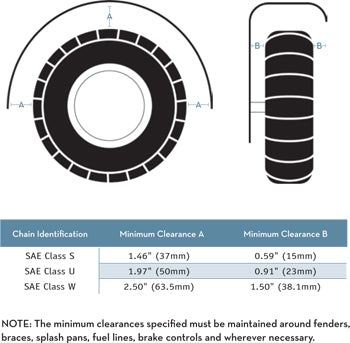
Definition of SAE classification
SAE class S:
Regular, non-reinforced passenger tire chains and cables for vehicles with restricted wheel well clearances.
SAE class U:
Regular, non-reinforced and lug-reinforced passenger tire chains for vehicles with regular, non-restricted wheel well clearances.
SAE class W:
Passenger tire chains that use light truck components, as well as some light truck chains.
Anti-Lock Brakes (ABS) & Four Wheel Drive
Anti-Lock Braking systems are not an alternative to traction devices. ABS assists in maintaining control and managing the vehicle's available traction more efficiently than a conventional braking system. When tire chains are installed, stopping traction for the ABS system is increased.
Although four-wheel drive and all-wheel drive vehicles have greater traction ability than two wheel drive systems, they do not have any advantages in stopping under winter driving conditions. It is recommended that all tires be equipped with tire chains on these vehicles.
Which Tires to Chain Up
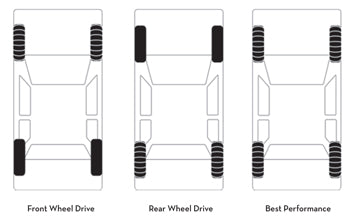
Tire chains should be installed on the vehicle's drive tires. On vehicles with front-wheel drive, this would be the two front tires and on vehicles with rear-wheel drive the two rear tires should be chained. If your vehicle has four-wheel drive or all-wheel drive, and you intend on chaining up only two of the tires, refer to your owner's manual for advice on which axle to chain up. To retain the best performance and handling from a four-wheel or all-wheel drive vehicle, install traction devices on all four tires.
Under normal driving conditions, a vehicle has about the same amount of traction at each wheel, creating a feeling of 'normal' control during braking, acceleration and cornering. Under snow and ice conditions, this balance is disrupted. If tire chains are installed on only the front tires, the rear of the vehicle can swing during braking and driving. If snow chains are installed on the rear tires only, the steering ability of the vehicle is limited. To get this balance back, the vehicle should be completely equipped with tire chains. Remember that tire chains are sold in pairs. Therefore, if you intend to install chains on all four tires, you must purchase two pair.
>> Back to top
|